
Free VPNs Without Data Selling: 5 Tested Providers
We all need to protect ourselves online — but we all want to save money too. Is it possible to protect yourself from malware and cyber threats (and unblock your favorite streaming sites) without spending a dime?
We reviewed some of the safest and most popular free VPN providers to find out what they’re really offering in terms of connection speeds, server locations, and other features.
 ExpressVPN
30-day money-back guarantee, no questions asked. Full-featured during the trial period.
From $3.49/mo
Get ExpressVPN Now
Why we picked it ↓
ExpressVPN
30-day money-back guarantee, no questions asked. Full-featured during the trial period.
From $3.49/mo
Get ExpressVPN Now
Why we picked it ↓
 ProtonVPN
Swiss-based, no data caps on free servers. No email required to sign up. Open source.
From $3.59/mo
Get ProtonVPN Now
Why we picked it ↓
ProtonVPN
Swiss-based, no data caps on free servers. No email required to sign up. Open source.
From $3.59/mo
Get ProtonVPN Now
Why we picked it ↓
 Windscribe
10GB/month free plan. No-logs policy court-tested in 2025. Built-in ad blocker.
From $5.75/mo
Get Windscribe Now
Why we picked it ↓
Windscribe
10GB/month free plan. No-logs policy court-tested in 2025. Built-in ad blocker.
From $5.75/mo
Get Windscribe Now
Why we picked it ↓
Jump to section
Quick Guide To Choosing a Free VPN
Choosing the best free VPN service isn’t easy. With so many available, it can be hard to find one that won’t harm you or your computer system.
Instead of downloading the first one you come across, which could sell your data, install malware, or throttle your bandwidth, you should ensure it’s a reputable provider with a trustworthy reputation.
When selecting a free VPN, there are a number of factors you should consider: encryption, logging policy, and data harvesting.
In a hurry? If you want the best VPN for privacy, security, or speed, here are our editor’s picks for the best VPNs overall — each with a 30-day money-back guarantee. So, although they might not be free, you’re free to try them for an entire month, on us.
Click through now to get our best discount on your subscription:
ExpressVPN: A global leader among VPNs, ExpressVPN offers one-click ease with high-speed servers in 105 countries — and it also unblocks Netflix. Get 3 months free when you purchase a 12-month subscription.
NordVPN: Compatible with many streaming services, featuring malware prevention and ad blocking. Get up to 66% off NordVPN’s 2-year plan with our special offer.
Surfshark: Award-winning VPN for unlimited devices, featuring worldwide connections with 10 GBit servers in 100 countries. Get up to 85% off Surfshark Starter 2-year plan plus 2 extra months free.
What To Look For
While most services are likely to offer a vast array, there are two key factors you should pay attention to first:
Strong Encryption
Whether you’re scouting for servers in the Netherlands, Germany, Japan, or anywhere else, strong encryption is vital to protect yourself online.
When choosing a free VPN provider, you should absolutely check whether they use strong encryption, such as AES-256, and that they offer a variety of VPN protocols to suit your needs.
A No-Logs Policy
There’s no point hiding your online activity from third parties if all of your information is logged by your VPN provider and stored in their servers (or worse, sold on).
To ensure your privacy, make sure any free VPN provider has a verified no-logs policy. This means they won’t store any identifiable information about you on their servers.
However, there are also some caveats to keep in mind when selecting a free VPN provider:
What To Avoid
While looking for everything you want in a good VPN, you should also make sure a service doesn’t include anything you don’t want. For example:
Data Harvesting
Unfortunately, services that have been acting as free VPNs have recently been outed for logging or harvesting customer data and then selling it to third parties.
It’s worth doing your research on a company before downloading its free VPN option.
The Best Free VPNs for Use in 2026
Due to the problems associated with free services, such as download restrictions, limited server locations, and the possibility of data logging, we don’t recommend using a free VPN.
Instead, we strongly recommend you buy a trustworthy VPN like ExpressVPN, our editor’s pick. It’s one of the fastest VPNs available, offering strong security features, servers in 105 countries, dedicated 24/7 customer support, and enhanced features that you can’t get from a free VPN.
That said, if you can’t afford a paid VPN at the moment – even one with a money-back guarantee – we’ve compiled a list of the best options for those who need a free VPN for a short period of time.
1. ProtonVPN
Best & Worst Features:
- Strict privacy rules, no data cap, and a no-logs policy
- Free VPN users can only access a limited number of servers
Developed by highly experienced scientists, engineers, and developers from CERN and MIT, Proton VPN uses AES-256 encryption while offering IKEv2/IPSec, OpenVPN, and WireGuard protocols.
The free version is subsidized by its paid plans and includes its kill switch and VPN Accelerator features.
With excellent security and privacy features, leak-free connections, and a no-logs policy, Proton VPN is one of the best free VPNs around, providing superior anonymity and protection free of charge.
No Logging Policy
Based in Switzerland, a country with strict privacy laws, Proton VPN only logs the user’s name, email address, IP address, timestamp, and billing information. No browsing history is kept, even on the free plan.
No Data Caps
One of the best features of the free Proton VPN is there is no data cap or speed limit. The only catch is you can access just three servers, in Japan, the US, and the Netherlands.
However, you can still watch videos, download files, and browse the web safely and securely without any fear of getting hacked while using public Wi-Fi or your home internet connection.
Unfortunately, the free VPN plan doesn’t allow users to access P2P sites. While this shouldn’t be a problem if you’re using an iPhone or Android device, if you try to visit one of these sites, Proton VPN will automatically log you out.
No Ads
Unlike many other free VPN services, Proton VPN has no advertisements, even for free users. It believes online privacy is a fundamental human right, and subsidizes its free plan through its paid plans.
Read our full ProtonVPN review
→
2. Hide.me
Best & Worst Features:
-
- No speed throttling for free users
- Free version only allows one simultaneous connection
Hide.me VPN’s free plan lets users access 8 server locations with a monthly data usage limit of 10GB per month and unlimited bandwidth. It uses AES 256 encryption and supports protocols IKEv2/IPsec, SoftEther, SSTP, OpenVPN, and WireGuard.
No Logging Policy
Hide.me VPN includes a strict no-logging policy and doesn’t store or sell any sensitive information.
It doesn’t have any ads or trackers either, so you can use the free plan without any interruptions.
24/7 Customer Support
Many VPN providers with free plans prioritize their paying customers when it comes to customer support. However, Hide.me VPN offers 24/7 for all its users, whether they’re on the paid or free plan.
P2P Support
Hide.me VPN supports torrenting and P2P file sharing on all 8 of its free server locations. If you download files online regularly, hide.me VPN will protect your IP address, encrypt your connection, and prevent potential bandwidth throttling.
However, users on the free plan are limited to a 10GB usage per month, which can be reached quickly if downloading large files.
Read our full Hide.me VPN review
3. AtlasVPN
Best & Worst Features:
- Unlimited number of devices
- Registered in a Five-Eyes Alliance country
AtlasVPN offers military-grade encryption options AES-256 and ChaCha20, with IKEv2 and WireGuard VPN protocols.
It also provides 24-7 support for both free and paid users through email (paid users can also use live chat).
No Ads Or Speed Limits
AtlasVPN’s free version offers no adverts or speed limitations. The company also claims to have a no-logs policy on both its free and paid versions.
However, it should be noted that AtlasVPN is registered in the US, which is a Five-Eyes Alliance member (meaning it shares information on its citizens with other authorities within the Alliance).
Unlimited Simultaneous Connections
AtlasVPN lets all users connect an unlimited number of devices at any one time, whether they’re using the paid or free plan.
However, the free plan is restricted to 5GB of data per month, which is per account and not per device.
Optimized Servers
AtlasVPN’s servers are streaming optimized, and also one of the few free VPN providers to offer P2p support.
The company has more than 1,000 servers in 42 countries, which is a reasonable amount despite not being as many as paid providers such as ExpressVPN.
It should be noted that free users can only access servers in 3 locations (1 in the Netherlands, and 2 in the US).PrivadoVPN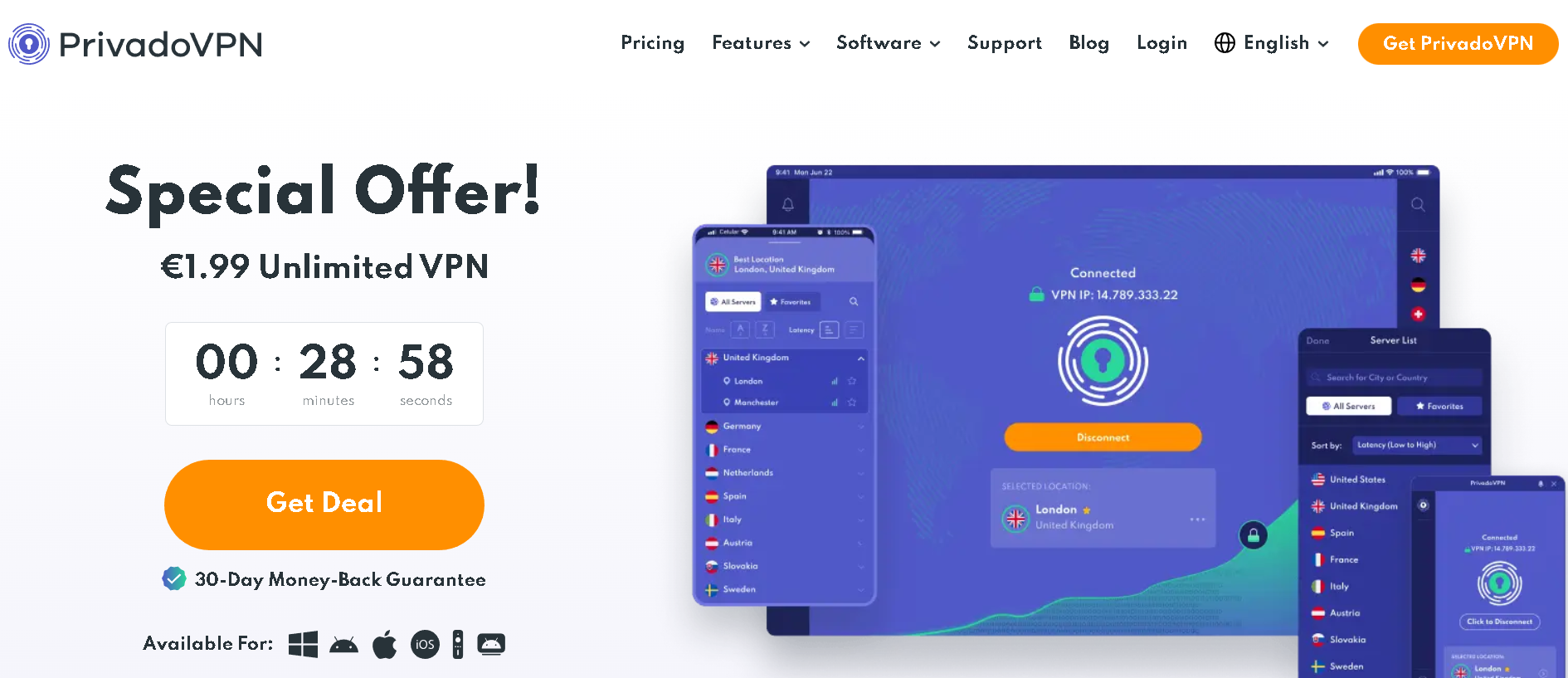
Best & Worst Features:
- P2p Support
- No 24-7 support option
| Pros | Cons |
| 12 country locations | No 24-7 support option |
| No-logs policy | Limited to 10GB data per month |
| Unlimited simultaneous devices | |
| Ad blocker |
Spanish for private, this zero-log VPN is relatively new, but its free version comes with many of the same features as the paid options. This includes industry-standard 256-bit encryption with IKEv2, OpenVPN, and WireGuard protocols.
In addition, PrivadoVPN provides DNS and IP leak protection, a kill switch, and a no-logs policy for all users.
It will also work on almost any device in your home, with a free app for most platforms.
12 Server Locations
PrivadoVPN lets its free users connect to servers in 12 different countries.
While this is still fewer than the 48 countries available to its paid plan users, it’s more choice than almost every other free VPN provider.
Server Infrastructure
PrivadoVPN’s free accounts use the same infrastructure as the premium ones, not just free servers like many others. This means VPN connection reliability and speed are the same as those experienced by paid plan users, and PrivadoVPN lets free users watch video and audio securely.
However, users on the free plan are limited to 10GB usage every 30 days, which can be reached quickly when streaming video and audio content.
In many cases, Privado VPN uses physical servers instead of virtual ones. Physical servers don’t experience the same type of slowdowns from overcrowding on virtual ones, but it means you’ll want to choose a server relatively close to your actual location in order to provide the best speeds.
Unlimited Simultaneous Connections
PrivadoVPN offers all users an unlimited number of simultaneous connections, so even free plan users can use multiple devices with the VPN at once.
Again, however, the free plan is restricted to 10GB of data every 30 days, which is per account and not per device.
Read our full Privado VPN review
Why Use a Free VPN?
The most obvious reason to use a free VPN is the cost. A reputable free VPN service will provide online privacy and protection without its user having to pay a cent.
However, choosing a VPN can be a difficult task, and that is especially true when it comes to selecting a free VPN provider. The free VPN market is a murky one and many so-called free VPN providers are merely harvesting your data to sell on to the highest bidder.
Here are some of the features you should consider when choosing a free VPN provider:
Number of Servers
Try to choose a service that allows you to connect to servers or countries around the world.
This is particularly important if you plan on using your free VPN to unblock content from streaming sites such as Amazon Prime, Hulu, Netflix, BBC iPlayer, or Disney+, as you’ll require a server in a location where the content is available.
More available servers also mean you’re less likely to experience slow speeds from congestion or the server being very far away.
Encryption Protocols
One of the main reasons people use a free VPN service is to remain anonymous and protect their personal information.
To ensure this, you’ll need a provider that utilizes the most up-to-date encryption, such as AES-256, and protocols including IKEv2, OpenVPN, or the newer WireGuard.
This will give you peace of mind knowing your data and details are well protected.
Logging Policy
Not only do you need to protect your personal information from unauthorized parties, such as your ISP, but you also need to ensure your free VPN service isn’t collecting it either.
Read through the provider’s terms and conditions to ensure your browsing history or sensitive details won’t be stored on the VPN’s servers or records.
To provide a free service and remain in business, some free VPN services will also sell your information to advertisers.
If you’re not sure, get in touch with a provider’s customer support to get explicit confirmation on their no-log policy.
Data Limits
One of the downsides of free VPNs is that they often come with a monthly data limit.
This can range from megabytes to a few gigabytes, which then refresh each month.
And, while there are a few that offer unlimited data usage, there might be a catch. It’s best to determine what you plan to use your VPN for, and then work out if the data limit is enough.
Network Speeds
If you’re using free VPNs to browse online safely, then you might not need to concern yourself with network speeds.
However, if you want to stream high-definition videos or download torrent files, then you’re going to want a service that can deliver. Many free VPNs will throttle the bandwidth compared to their paid options, so make sure this isn’t a restriction before you activate your service.
Concerns About Free VPNs
These days, a VPN is vital for safety and privacy online. Since a VPN works by encrypting your data and tunneling it through one of the VPN servers, you must be careful when selecting a free VPN provider.
Avoid any providers that are known to be harvesting or selling user data, as well as those that plague you with adverts while you are trying to use the internet.
Why Use a Paid VPN Instead of a Free VPN?
While we’ve provided a list of the best free VPNs above, there’s no match for a premium VPN service.
Whether it’s to be certain your data is safe, to avoid usage caps, to access more servers and locations, or because you need extra features such as ad-blockers or split-tunneling, it’s usually worth paying out a few dollars each month for a reputable premium VPN.
Here are some of our top picks of paid VPN providers you might want to consider:
ExpressVPN
Our Deal: $6.67 per month for 12 months + 3 months FREE
ExpressVPN is a well-established service that’s been operating for more than a decade.
Labeling itself as the “#1 trusted leader in VPN”, with high-speed, ultra-secure servers, it stands out for its speed, privacy, and unblocking capabilities, and is generally regarded as one of the highest-quality VPNs overall.
Privacy
ExpressVPN’s privacy policy states it does not log any traffic or session data and does not store connection time stamps, used bandwidth, or IP addresses. Registered in the British Virgin Islands, it has no legal obligation to keep data for a certain period of time.
ExpressVPN regularly invites third-party auditors to test and confirm these claims, the most recent of which was at the end of 2022.
In 2017, the Turkish Government seized an ExpressVPN server, but it held no useful information for the authorities, verifying ExpressVPN’s no-log policy.
To pay for your subscription, you can use a credit card or PayPal, but the service also accepts Bitcoin and various other payment methods that are anonymous or more difficult to track.
Servers
With 3,000+ servers across 105 countries, ExpressVPN offers a fast connection from pretty much anywhere. It’s one of the few providers that offers locations in every continent except for Antarctica.
The main benefits of this include higher speeds, a wide range of server locations for bypassing specific geo-restrictions, and compatibility with both desktop and mobile devices.
Works for all popular streaming services
Many streaming services actively block VPN services, particularly Netflix which is well-known for geo-restricting its content. But ExpressVPN is one of the few providers that we’ve been able to access and unblock Netflix with while using, even when outside of the US.
With a host of features, fast speeds, and a proven reputation, NordVPN is a relatively inexpensive service, considering other market offerings.
Privacy
If you’re looking for a VPN company that respects your privacy, that’s NordVPN. Based in Panama (known for its privacy and tax haven for many offshore companies), it has a strict no-logs policy that’s been independently verified multiple times.
NordVPN also operates on diskless servers, meaning no user data or information is written to the hard drive. The service also offers servers with obfuscation and double VPN features.
Speed
NordVPN claims to be the fastest VPN on the planet. An independent, third-party security institute, AV-TEST, ran tests on the most popular premium VPN services and found NordVPN to be almost twice as fast as the next provider.
Its fast speeds are made possible by NordVPN’s revolutionary NordLynx protocol and wide global network of 8,400+ servers capable of 10Gbps, meaning you should be able to do any data-heavy activity, such as streaming, without any disruptions.
Huge Number of Features
NordVPN comes with a huge number of additional features – more than almost all other premium VPN providers. This includes two kinds of kill switch, split-tunneling, mesh net, in-built leak tests, private DNS, Threat Protection, and Passport Manager.
The Threat Protection feature is particularly impressive. It provides an extra layer of security by filtering harmful content before it reaches your device, scanning files for malware while you’re downloading them, and blocks ads, trackers, and malware URLs to prevent any malicious threats. Most VPN services charge extra for these kinds of anti-virus features, but NordVPN includes Threat Protection with all its plans.
 Read our full NordVPN review
→
Read our full NordVPN review
→
Surfshark
Our Deal: Surfshark Starter at $1.99 ✓ Mar 18, 2026 for 2 years + 3 months FREE
Best & Worst:
- Surfshark lets users connect an unlimited number of devices simultaneously – one of the only premium providers to not impose a limit, making it suitable for large families or those who often switch between many devices at any one time.
- While it offers an impressive array of features, not all of them are available on all platforms and devices, and some (such as antivirus and dedicated IP) cost extra.
Surfshark is a relatively new company, offering a large number of features at a low price. The app is highly secure and can be used on an unlimited number of devices simultaneously, whereas most existing providers cap this number below 10.
Low Costs
Surfshark is currently the best VPN service for those on a budget. Depending on the length of plan you choose, it can cost as little as a couple of dollars a month, making it one of the best value VPNs on the market.
And, compared to other low-cost VPN providers, Surfshark maintains a high level of privacy and security standards, with a strict no-log policy that’s been independently verified.
On top of that, Surfshark is one of the only premium VPNs to offer a free trial as well as a 30-day money-back guarantee – so you can try it out before committing any money.
Unlimited Simultaneous Connections
Unlike other services, which limit the number of devices you can use with their VPN at any one time, Surfshark lets its users connect an unlimited number simultaneously, with just one account. This makes it perfect for large families.
Huge Number of Additional Features
Despite its low price point, Surfshark comes with all the standard features you’d expect from a premium VPN service, plus many, many more.
These include Clean Web 2.0 (Surfshark’s ad and tracker blocker), kill switch, split-tunneling, camouflage mode, NoBorders, IP rotator, pause VPN, and obfuscated and multi-hop servers.
 Read our full Surfshark review
→
Read our full Surfshark review
→
Our Methodology
Did you know there are over 50 VPN services on the market today? That’s a lot of research to do to find out which one is the best free VPN for you. However, it doesn’t have to sit all on your shoulders. We complete extensive and thorough reviews of every product.
We don’t get any unique downloads from providers either. We use the products that are available for the general public to download and put them through their paces to ensure it’s going to meet your expectations. Here are some examples of what we look for when choosing the best free VPNs.
Privacy
Our privacy review starts by researching the company itself. We take a look at their court history and where the head office is located. We’ll even dig deeper into how payments are processed and anything else we can find on business practices. Our team also combs through the privacy policy and analyzes every syllable to make sure the company isn’t going to be logging your information while you’re browsing.
Next, we’ll perform some DNS leak tests to ensure the free VPN hides all details.
Speed
We run multiple speed tests when trialing a free VPN. After establishing a baseline result, we’ll start connecting to numerous servers in countries around the world. Then we’ll take note of download and upload speeds and compare them to the baseline result.
User Experience
Running a free VPN shouldn’t require you to earn an IT degree. While we know our way around VPN products, we grade based on simplicity. The easier it is to connect to a server of your choice, the better. This experience should be identical no matter what device you’re installing your VPN on. For example, it should be just as seamless on an iPhone as it is on a laptop.
Our Verdict
They say nothing in life is free. But this isn’t true when it comes to VPNs, and in the cybersecurity world, you certainly get what you pay for.
While there are free VPN services that offer security, no-logging policies, and lots of other good features, can you really afford to trust a free provider with your online security?
Ultimately, if your online privacy is important to you in the long term then you will do best by paying for a paid VPN provider such as ExpressVPN as you will benefit from their premium services, larger number of servers, and generally better quality experience.
Our picks compared
| ExpressVPN | NordVPN | Surfshark | ProtonVPN | Windscribe | |
|---|---|---|---|---|---|
| Best rate | $3.49/mo | $3.09/mo | $1.99/mo | $3.59/mo | $5.75/mo |
| Monthly price | $12.99 | $12.99 | $15.45 | $9.99 | $9.00 |
| Servers | 3,000+ | 8,400+ | 4,500+ | 15,000+ | 480+ |
| Countries | 105 | 167 | 100 | 120 | 69 |
| Devices | 8 | 10 | Unlimited | 10 | Unlimited |
| Jurisdiction | 🇻🇬 BVI ⓘ | 🇵🇦 Panama ⓘ | 🇳🇱 Netherlands ⓘ | 🇨🇭 Switzerland ⓘ | 🇨🇦 Canada ⓘ |
| Money-back | 30 days | 30 days | 30 days | 30 days | 7 days |
| Kill switch | ✓ | ✓ | ✓ | ✓ | ✓ |
| Split tunneling | ✓ | ✓ | ✓ | ✓ | ✓ |
| No-logs audited | ✓ | ✓ | ✓ | ✓ | ✗ |
| Dedicated IP | ✗ | ✓ | ✗ | ✗ | ✗ |
| Review | Read review → | Read review → | Read review → | Read review → | Read review → |
| Get ExpressVPN Now | Get NordVPN Now | Get Surfshark Now | Get ProtonVPN Now | Get Windscribe Now |
VPNs we don't recommend
Transparency matters. Not every VPN earns our recommendation. Here's why some rank at the bottom:
Hola VPN
- Routes traffic through other users' devices, not VPN servers
- Your bandwidth is sold to third parties
- No encryption on free tier
- Logs all user activity
- Previously linked to a botnet incident
Ivacy VPN
- DNS leaks detected in our testing
- Leaking DNS queries defeats the purpose of a VPN
- Disputed ownership (Gaditek/Disrupt connection)
Avast SecureLine VPN
- Parent company fined $16.5M by FTC (2024)
- Sold user browsing data via Jumpshot subsidiary
- Only 55 servers in 34 countries
How we chose these VPNs
Every VPN on this page goes through the same independent testing process. No provider pays for a ranking. ExpressVPN is our featured partner (clearly disclosed), but that relationship does not influence the testing methodology applied to every other provider on this page.
Leak tests
IP address, DNS, and WebRTC leak detection using our own testing tool
Speed tests
Download, upload, and latency measurements across multiple server locations
Streaming access
Testing against Netflix, Hulu, BBC iPlayer, Disney+, and other major services
Privacy policy review
Jurisdiction analysis, logging policy audit, and independent audit verification
App quality
Usability testing on Windows, macOS, iOS, Android, and browser extensions
Value assessment
Price per month, money-back guarantee terms, and feature-to-cost ratio
Frequently Asked Questions (FAQs)
Which is the best free VPN?
The best all-around free VPN is Proton VPN. It features a no-logging policy and doesn’t have a data limit, which is particularly generous compared to other free providers.
ProtonVPN works well on all devices, with a user-friendly interface that anyone can operate to feel secure that their sensitive information is protected while they browse online.
Why is a free VPN not recommended?
While there are free VPNs that are safe to use, they’re often limited in features, the amount of data allowed, or the number of servers available.
Many will still offer top-of-the-line security protocols and are free from DNS leaks. However, not all have proven no-log policies (like most paid VPN services do), so it is highly recommended users read the terms and conditions of any provider before signing up, to ensure no browsing history or personal information will be collected and/or sold to third parties.
What is the difference between free VPNs and paid VPNs?
The companies providing free VPNs often have paid options as well. The free option is a way for people to try before buying or for those who don’t use the internet regularly enough to justify a subscription cost.
However, some other free VPN providers make their money by selling their users’ information to third parties. They track the country users connect to and the websites they visit so advertisers can sell targeted products and services.
Paid VPNs usually have strict and verified no-log policies, so users won’t have this problem when using a premium provider. Paid VPNs will most likely offer more options and features, as well as provide prioritized customer support.
By use case
By device
By country
Update history
This page was revised 20 times between September 2021 and April 2026.
Linked jurisdiction information to ownership documentation for transparency.
Removed defunct provider listing and upgraded free VPN comparison with verified specs, standardized pros/cons, and visual review links for each provider.
Restructured entire article with new introductory section, expanded guidance on selecting free VPNs with encryption and no-logs policy details, added premium VPN recommendations with discount links, and reorganized content hierarchy.
Restructured introduction and added promotional sections highlighting paid VPN alternatives with discounts before discussing free options.
Restructured opening section to add "Quick Guide To Choosing a Free VPN" with subsections on encryption, logging policies, and data harvesting risks before individual VPN reviews.
Restructured introductory section with new "Quick Guide" and decision framework, added comparison of three premium VPN options with current pricing, and reorganized "What to Look For" and "What to Avoid" subsections for improved clarity.
Restructured intro and early sections, moved paid VPN recommendations higher, added detailed comparison tables for ProtonVPN and other free VPN services.
Rewrote opening paragraphs for clarity, reorganized free VPN selection criteria into distinct subsections with expanded explanations, and streamlined promotional content for paid VPN alternatives.
Removed outdated 2023 publication references and updated free VPN provider listings with current offerings and specifications.
Removed redundant subsections on encryption protocols and logging policy, consolidating overlapping content about VPN security features.
Rewrote introduction for clarity, corrected "delve in to" to "delve into," fixed capitalization of "VPN" inconsistencies, and improved table formatting throughout.
Added introduction section with best practices guide covering encryption standards, no-logs policies, and red flags for free VPN selection.
Added introductory section explaining why free VPNs matter, expanded content structure with detailed overviews of five providers, and included strengths/weaknesses tables for each service.
Added introduction section explaining free VPN benefits and risks, plus new guide to selecting free VPNs covering encryption, no-logs policies, and data-selling concerns.
Removed outdated 2021 references and updated provider list with current best free VPN services for 2024.
Rewrote introduction for clarity, restructured strengths/weaknesses presentation, and removed incomplete sentence at end of PrivadoVPN section.
Rewrote introduction paragraph to emphasize user cost concerns and clarified VPN selection criteria before presenting provider list.
Restructured introduction from three paragraphs into concise opening, reorganized VPN list into roundup section, and simplified language throughout for clarity.
Restructured opening paragraphs for improved flow and clarity, reorganized content hierarchy with proper heading structure.
Reorganized content hierarchy by promoting "The Best Free VPNs" from H2 to H1, streamlining the page structure.
The Marriott breach (2018) exposed 500 million guest records including passport numbers, staying dates, and payment card details.
Source: Marriott International, 2018